
DEFENSE SOFTWARE AND AI
The software platform for
AI-enabled defense systems
Modern defense systems don’t lack capabilities, but they often fail to operate as one system.
Apex.AI Defense provides the interoperability, autonomy, and AI backbone that enables heterogeneous systems to operate as one across vendors, domains, and missions.
We connect systems instead of replacing them.


01.
Proven in safety-critical production
Deployed in real-world, safety-critical systems and not just tested in prototypes or lab environments.
02.
Open, controllable, and secure
Source-available software with deterministic behavior, auditable execution, and flexible deployment options aligned with defense requirements.
03.
From prototype to deployment
ROS-compatible and road vehicle-certified, providing a direct path from development to fielded systems.
OPERATIONAL OUTCOMES
Software-defined defense on existing systems and architectures
Reduce integration timelines from years to months. Maintain full operational control. Enable multi-vendor architectures without rebuilding.
01.
Multi-vendor systems that operate as one
Integrate platforms, payloads, and software from different vendors into a unified, mission-ready system.
02.
Faster program execution
Replace fragmented integration efforts with a reusable, production-proven foundation.
03.
Continuous capability evolution
Move from distributed development across multiple organizations to a scalable, certification-ready platform in months—not years. Reduce risk with proven production experience.
04.
Reduced dependency on individual vendors
Deterministic execution and record/replay capabilities enable traceable analysis, controlled release, and forensic review of AI and mission-critical systems across development, testing, and operations.
ARCHITECTURE
The Apex.AI modular defense stack
A composable architecture for integrating and operating multi-vendor defense systems.
Software and AI factory SDK — Apex.Alan
Testing and validation SDK — Apex.OS for V&V
Compute / system-on-chip
Operating system
Platform / vehicle
Edge-to-cloud communication SDK — Apex.Ida
Edge and cloud runtime SDK — Apex.Grace
Multi-domain operations
Command and control
Unmanned vehicles
Third-party vehicles
Agentic AI decision support
AI-based situational awareness
Mission SDK
— Apex.Autonomy
Third-party software modules
RUNTIME INFRASTRUCTURE
Runtime SDK for mission-critical software execution
A runtime SDK for execution of complex defense software with predictable execution timing on resource-constrained embedded edge systems and across fog and cloud environments.
It provides the application runtime layer for software-defined defense systems, enabling autonomy, AI, mission logic, and legacy software to operate in production-grade environments across heterogeneous platforms.
The runtime infrastructure enables defense teams to move from prototype code to field-ready systems without a full software reset.
Key capabilities
Edge-ready AI and autonomy
Run autonomy functions and AI models in real time on military hardware, including resource-constrained embedded systems.
MOSA and JADC2 alignment
Act as a glue layer for interoperable, modular systems that support multi-vendor integration and scalable modernization.
Legacy system modernization
Isolate legacy software and connect it into modern architectures without replacing the entire system.
Path to certified production systems
Upgrade existing and prototype code toward production-grade, safety-certified execution environments.
COMMUNICATION INFRASTRUCTURE
Communication SDK for secure
multi-domain data exchange
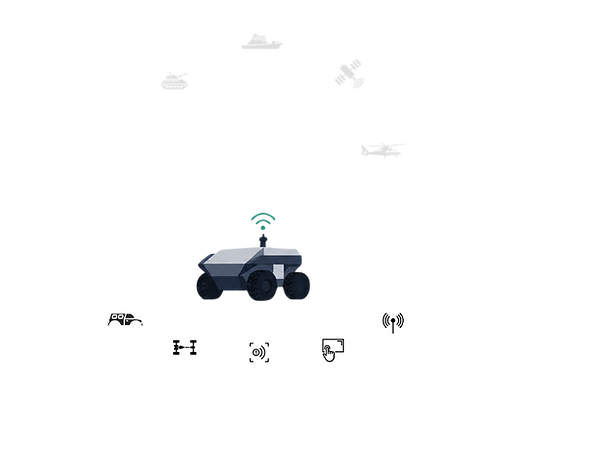
The SDK provides secure, high-performance data exchange across vehicles, sensors, payloads, operators, cloud systems, and command and control environments.
It provides a single application-oriented API for combat-system communications while remaining hardware-independent, portable, and easy to maintain.
The communication infrastructure provides intra-edge and edge-to-fog-to-cloud data transport with deterministic behavior.
Key capabilities
One API for multi-domain communication
Connect autonomous and operator-assisted systems, sensors, payloads, C2 cloud, SATCOM, Link 16/22, UHF/VHF, mobility, chassis, crew interface, and software-update systems through a unified communication layer.
Gateway-based connector architecture
Integrate proprietary sensors, custom protocols, and external communication interfaces through flexible connectors and isolated gateway processes.
Hardware and RTOS independence
Allow platforms, devices, and operating environments to evolve or be swapped without disrupting software development or system capabilities.
High-performance deterministic data transport
Use shared-memory, zero-copy communication for low CPU utilization, scalable throughput, and predictable low-latency data exchange.
Secure and safety-aware communication
Support identity and access management, authentication, encryption, end-to-end data protection, and mixed-criticality systems.
SOFTWARE FACTORY INFRASTRUCTURE
Software factory SDK for defense-grade software and AI delivery
A software factory SDK for building, validating, deploying, and maintaining software and AI capabilities across defense programs.
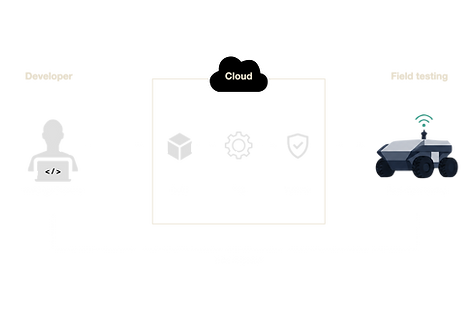
It replaces fragmented development silos with an integrated software and ML factory architecture that connects requirements, documentation, software and model development, build systems, testing, deployment, and field feedback.
This defense software factory enables faster iteration from code to capability. It provides the connection between AI-based software and the physical world of defense by automating the building, testing, and deployment of software and AI models
Key capabilities
Integrated development workspace
Bring requirements, design, software, models, builds, validation, deployment, and documentation into a cohesive engineering environment.
Automated integration and deployment
Implement CI/CD workflows for software and AI development, testing, deployment, and maintenance.
From code to features in days instead of years
Support rapid development and test cycles across application engineers, V&V teams, suppliers, partners, cloud testing, device farms, and field-testing environments.
Continuous validation and traceability
Enable bi-directional traceability across requirements, software, models, tests, and deployment artifacts.
Faster feedback loops
Shorten developer feedback time and accelerate software integration, release, and field iteration.
TESTING AND VALIDATION INFRASTRUCTURE
Verification & Validation SDK for mission-critical software deployment
The SDK enables fast-track testing, validation, release, and deployment of mission-critical defense software.
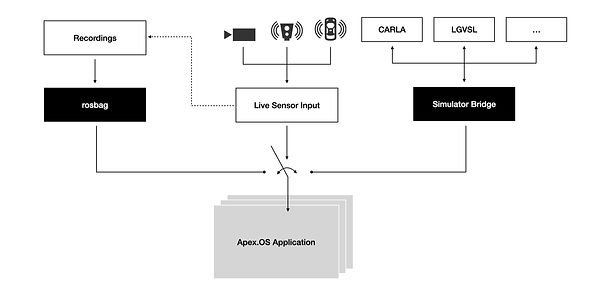
It supports deterministic data recording and replay, trace-data analysis, automated testing, and middleware-level validation workflows. This allows engineering teams to reproduce system behavior with the same timing and content, making analysis, debugging, and performance evaluation faster and more reliable.
The SDK reduces validation effort while increasing confidence in automated and operator-assisted systems.
Key capabilities
Deterministic data recording and replay
Record data in-vehicle and replay it with the same timing and content for reproducible analysis and validation.
Core runtime validation
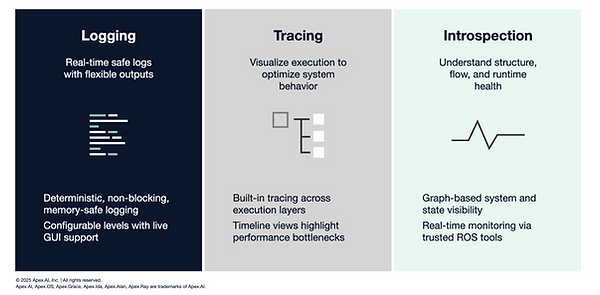
Validate key runtime functions including node execution, execution monitoring, system monitoring, and diagnostics.
Zero-copy middleware validation
Use inter-process communication via zero-copy shared memory with data-integrity checks for robust, high-performance test environments.
Trace-data analysis
Analyze system behavior across execution flows, communication paths, and runtime events.
Parallelized testing workflows
Run tests in parallel to accelerate verification cycles across software and system configurations.
ROS
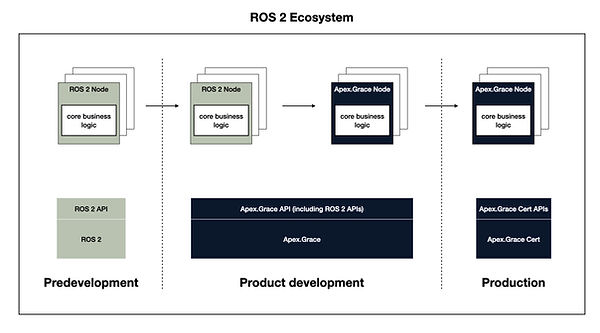
ROS compatibility: From prototype to production
Connecting what engineers build (ROS) to what gets deployed (Apex.OS).
Reuse existing ROS and ROS 2 nodes and architectures to avoid full system rewrites
Transition from R&D to production-grade, deterministic, safety-critical runtime in months instead of years
API-compatible with ROS-Military and Space ROS to enable reuse of existing drivers, tools, and software
Prototype → Production. No reset required.
OPERATIONAL CREDIBILITY
Proven foundation for mission-critical systems
Deployed. Not experimental.
Deployed in multiple domains
On-road, off-road, marine systems
and cloud/backend
Deployed in safety-critical environments
Systems requiring deterministic behavior, reliability, and certification.
Deterministic, auditable execution
Predictable, traceable system behavior across development and operations.
From prototype to deployment
ROS-compatible and road vehicle-certified—bridging development and fielded systems.
Open and standards-based
Open architecture
No dependency on a single vendor, hardware platform, or national stack.
Aligned with MOSA principles
Modular, interoperable design supporting long-term evolution.
Source-available software
Full transparency for audit, inspection, and operational confidence.
Flexible deployment
Deployable in secure, on-premises, national, or alliance-compliant environments.
CERTIFICATIONS
ISO 26262 — Functional safety
ISO/SAE 21434 — Cybersecurity
ISO 27001 — Information security
TEAM
A senior engineering team with decades of experience building autonomous and safety-critical systems—from DARPA challenges to series production. The team includes long-standing contributors to ROS and ROS 2 with deep expertise in open-source robotics ecosystems.
TECHNICAL CONVERSATION
Apex.Grace는 응용 프로그램 개발자로부터 기본 구성 요소의 복잡성을 추상화합니다.
We don’t offer just sales calls. We offer technical discussions. Tell us where your system architecture needs to go. We’ll tell you honestly whether, and how, we can help.